

Anger is the most reliable currency in the modern digital economy. In the algorithmically driven corridors of the internet, outrage and fear don’t merely capture attention; they generate staggering amounts of capital. But within specific, highly trafficked intersections of the conservative evangelical and post-evangelical world, a distinct brand of vitriol has been painstakingly optimized into a corporate business model: the subjugation of women.
Welcome to the “hate-grift”; a hyper-efficient, media-driven machine built entirely on harvesting male alienation. The architects of this ecosystem identify a demographic of men who feel culturally displaced, economically anxious, or relationally frustrated, and capture this raw psychological despair, converting it into a highly profitable consumer base. The product delivered to market is the absolute, unquestioned subordination of women, packaged not as cruelty but as a divine, unalterable cure-all for societal decay.
To understand how the modern evangelical palette was conditioned to accept the most extreme iterations of this movement, we must abandon the comforting illusion that today’s hardline patriarchy is a sudden theological aberration. It’s not a glitch in the system, but the logical, fully evolved manifestation of mid-twentieth-century complementarianism.
Decades before the advent of social media algorithms and insular digital echo chambers, the ideological groundwork for the hate-grift was laid in the foundations of conservative institutions by men like Wayne Grudem, John Piper, James Dobson, and John MacArthur. Through entities like the Council on Biblical Manhood and Womanhood, these founding figures mainstreamed a theology asserting that men and women were “equal in value but distinct in roles.”
They cloaked this hierarchy in the warm, pastoral language of benevolence, calling it “protective servant leadership.” Men were designated as loving, visionary providers, while women were tasked with being joyful, submissive responders. However, regardless of how softly it was preached, the foundation was always structural inequality. By normalizing the premise that women are inherently designed to be led, directed, and barred from ultimate executive or spiritual authority, these early frameworks conditioned generations of believers, teaching an entire subculture to view female autonomy not as a basic human right but as an active, dangerous rebellion against God.
As this complementarian paradigm aged, the Overton window was deliberately kicked open. Ideologies rarely remain stagnant, especially when fueled by the internet, which demands increasingly extreme content to maintain user engagement. The soft, protective language of early complementarianism began to look insufficient, even effeminate, to a vanguard of men radicalized by modern culture wars.
Figures like Doug Wilson spent years cultivating an unapologetic, sharply cynical brand of Christian Nationalism, setting an explicit template for a younger, more aggressive contingent. Today, provocateurs like Dale Partridge, Brian Sauvé, and Joel Webbon have dropped the benevolent mask entirely. The language of “servant leadership” has been usurped by the rhetoric of conquest, dominion, and uncompromising household tyranny. In this new frontier, women’s voices aren’t merely subordinated; they’re actively mocked.
We must recognize that this is no longer a fringe subculture content with staying on the sidelines. The modern patriarchal movement has scaled its operations from obscure blogs to the highest echelons of institutional and political influence. Consider the recent, staggering trajectory of Doug Wilson. This is a man who openly advocates the repeal of the 19th Amendment, dismissing women’s suffrage as a mistake and arguing for “household voting”—where a woman’s civic voice is entirely erased and absorbed by her husband. He defends historical slavery and boldly outlines a 250-year vision to transform secular democracies into rigid Christian theocracies where non-Christians are legally barred from holding public office.
And yet, this same man was recently invited by the United States Secretary of Defense to deliver a sermon at the Pentagon.
The hate-grift is interfacing with the state. The movement’s architects are no longer hiding their endgame; they openly boast of a sociopolitical vision in which alternative beliefs, basic civil rights, and female autonomy are systematically revoked. What begins as a theological restriction in the sanctuary is actively mutating into a demand for total civic and political disenfranchisement.
This progression represents a calculated trajectory of social engineering; operating not just as a fringe theology but as a profound public health crisis and a systemic engine for generational trauma. To dismantle it, we must examine the architecture of the grift in its entirety. We’ll peel back the layers of this machine, moving through concentric circles of control. We’ll expose the cultural machine that isolates and trains disaffected men, the economic ledger that ruthlessly funds the grift, and the relational cage it builds within the home. Finally, we’ll penetrate the deepest, most devastating layer: the profound biological and physiological pathology this theology inflicts upon the bodies of the women trapped inside it.
The empire is operating in plain sight. It’s time to name the sickness.
The Cultural Machine
To sustain a highly profitable, self-replicating ecosystem of control, the patriarchal hate-grift requires a steady stream of eager consumers. The architects of this movement don’t cast a wide net; they target a specific demographic. They seek out lonely, disaffected, and often economically displaced men who feel a profound sense of loss amid a rapidly evolving social landscape. When men lose structural power or personal agency in the modern world, the grifters offer them a seductive, neatly packaged theological scapegoat—female independence—and an intoxicating promise: the reclamation of absolute, unquestioned dominion.
The indoctrination process requires a complete warping of a man’s foundational understanding of human relationships. By intertwining hyper-conservative theology with rigid gender hierarchies, influencers train followers to view male dominance and female submission not merely as a cultural preference but as the only natural, divinely ordained order. Clinical and social psychological studies show that when men hold beliefs rooted in traditional masculine ideology, they often justify controlling, possessive, or aggressive behaviours as mere expressions of love, protection, or necessary responses to a woman’s perceived provocations.
The perpetuation of specific myths of romantic love reinforces this dangerous conditioning. These narratives—which rely on the belief that there’s a perfect partner who exists solely to satisfy all needs, or that jealousy is an authentic expression of love—legitimize dating and marital violence by masking abusive actions as passion, protection, or leadership. When a religious influencer tells a man that guarding his wife requires micromanaging her life, he’s not teaching biblical care. He’s weaponizing the myth of the ideal soulmate to enforce coercive control, effectively preventing recognition of certain actions as violent. Because these men are taught that their partner is uniquely responsible for satisfying all their emotional and psychological needs, the inevitable failure to meet this impossible standard leads directly to profound relationship dissatisfaction and marital dysfunction.
This conditioning manifests through pipelines that vary slightly by a man’s marital status, though the underlying pathology of entitlement remains the same.
For single men, these teachings often serve as an onramp to the darker, more aggressive corners of the digital landscape. The ideological boundary between secular extreme subcultures and this brand of radicalized Christian patriarchy is increasingly porous. This is most evident in the integration of the “Red Pill” movement, which promotes ideas such as controlling a partner’s friendships, dictating what she wears, explicitly discouraging her from attending university, and isolating her from any influences that could jeopardize the relationship. By framing women as inherently subordinate, these teachings groom young, single men to view women not as intellectual peers or co-heirs of grace, but as territory to be conquered and rigidly managed.
For married men, this conditioning manifests as what can only be termed “pious tyranny.” The home is fundamentally reconstructed as a sovereign kingdom in which the husband serves as the undisputed monarch. Strict definitions of “masculinity” and “femininity” give rise to gender role stereotypes that attribute family leadership and income generation entirely to men, enforcing an artificial power dynamic that damages the health and status of both partners. Because the theology demands that he lead perfectly and she submit entirely, any instance of marital friction is automatically diagnosed as the wife’s failure to submit. The husband, armed with hours of podcast content and digital courses produced by patriarchal influencers, micromanages the household, uses scripture to weaponize every disagreement, and views empathy, vulnerability, or compromise as a dangerous abdication of his divine authority.
Perhaps the most terrifying aspect of the patriarchal hate-grift is its long-term, calculated impact on the next generation. We’re witnessing the systematic cultivation of boys who are being actively trained out of their innate capacity for emotional resonance. In these hyper-patriarchal systems, children internalize messages that associate masculinity exclusively with assertiveness, dominance, aggression, and independence, while boys are expected to suppress their emotions.
By raising sons in an environment where expressing vulnerable emotions is labelled as dangerous fragility, the movement ensures that the cycle of domestic abuse—whether physical, emotional, or psychological—will perpetuate indefinitely. The internalization of these gender-conforming schemas begins in early childhood, deeply shaping how the next generation regulates their emotions and constructs their identities. Boys raised in this ecosystem are being explicitly groomed to become the next generation of domestic tyrants. At the same time, girls are being conditioned to quietly absorb the physiological and psychological trauma of their future husbands.
The influencers creating and selling this content aren’t merely damaging today’s marriages; they’re actively seeding a long-term public health crisis for tomorrow. They’re banking on the reality that if they can convince a young man that his relational dissatisfaction is actually a crisis of insufficient dominance, they can ensure he remains a lifelong consumer of their brand of “biblical” correction.
The Political Economy of Control
The modern extreme-patriarchy movement isn’t merely a fringe theological sect or an accidental cultural phenomenon; it’s a highly optimized digital business model. Behind the veneer of theological purity and pastoral concern lies a calculated machine designed to generate staggering revenue by exploiting male insecurity. To understand the longevity, rapid spread, and unrelenting aggression of this ideology, we need to follow the money. The hate-grift doesn’t sustain itself on zeal alone; it requires a robust, diversified, and fiercely protected financial infrastructure.
In the digital age, algorithms are agnostic to truth, but they’re highly sensitive to engagement—and nothing drives engagement quite like outrage, fear, and controversy. The architects of the hate-grift are acutely aware that social networks offer the easiest way to rapidly reach a wider audience and build a massive consumer base. By staking out increasingly extreme, polarizing positions on gender roles, these figures guarantee themselves a steady stream of algorithmic promotion.
They understand that cultural narratives often already romanticize dominant, controlling behaviours, softening the ground for their extremist rhetoric to take root. To maximize their reach and consolidate power, these creators actively cross-pollinate their platforms, forming strategic partnerships with influencers and brands with larger audiences—a recognized, highly effective method for building and radicalizing a specific demographic. They’ve successfully monetized the culture war, transforming theological subjugation into a reliable, scalable media empire.
The monetization of this ideology is vast and sophisticated. Men alienated by modern society are systematically funnelled into a highly lucrative sales pipeline. The products of this grift include:
Bestselling books outlining “biblical” blueprints for reclaiming absolute masculinity and enforcing household discipline.
Exclusive community subscriptions that provide access to private, radicalized echo-chamber forums, hidden behind recurring monthly paywalls.
High-priced online courses and “masculinity masterclasses” that promise to teach men how to lead their homes forcefully.
Premium tickets to men’s conferences and retreats that function more like militant political rallies than like spaces for spiritual reflection or repentance.
The most insidious aspect of this economic ecosystem is the mechanism it uses to ensure customer retention: influencers intentionally sell a disease and market it as the cure.
They deliberately foster a deep sense of inadequacy in their male followers, convincing them that any relational friction, lack of respect, or personal unhappiness is the direct result of not being dominant enough. Simultaneously, they advocate domestic structures that ensure women remain entirely stripped of their autonomy. They aggressively enforce economic inequalities, pushing rigid, single-income models that explicitly restrict a woman’s independence and vocational capacity.
This isn’t merely a cultural preference; it’s a calculated trap. Financial dependency is clinically recognized as one of the primary reasons victims are forced to remain in abusive relationships. By aggressively enforcing these roles, these influencers perpetuate the exact economic and relational imbalances that erode a woman’s mental health and trap her in an environment she can’t afford to escape.
They manufacture a household dynamic guaranteed to produce misery, resentment, and chronic stress. They teach men maladaptive, abusive behaviours that destroy emotional intimacy. Then, when the marriage inevitably begins to fracture under the crushing weight of coercive control, the influencer is waiting with a new book, a new podcast episode, and a new paid seminar promising the ultimate fix. The grift survives because the “cure” it sells is specifically designed to keep the patient sick, ensuring the cash flow ledger remains permanently in the black.
This highly profitable cycle reveals a profound spiritual cynicism. To grasp the sheer theological betrayal at play, we must recognize what the establishment is actually selling.
In Genesis 3, the power struggle between men and women—the agonizing reality of male domination—is presented as the tragic consequence of the curse, an infection of sin into the created order. The Gospel of Jesus Christ is meant to violently reverse that curse, restoring mutuality, dignity, and liberation. But reversing the curse doesn’t yield earthly power or algorithmic engagement.
Instead of fighting the darkness of the Fall, the modern patriarchal establishment has chosen to institutionalize it. They protect the curse because they’ve learned to monetize the poison. They capitalize on a demographic of lonely, disaffected men, weaponizing their frustrations and translating their radicalized anger into a steady, diversified cash flow. Whether driven by sincere, albeit toxic, theological conviction or the sheer allure of wealth, the outcome is the same. The gatekeepers of the hate-grift are getting rich off the biological and psychological destruction of women, cackling all the way to the bank. At the same time, their followers build invisible cages in their own homes.
The Relational Cage
To fully capture the devastation wrought by the modern patriarchal machine, we have to step out of the digital marketplace and into the living room. When an ideology demands that men conquer and women submit, the home ceases to be a sanctuary, and becomes a geopolitical briefing room and, ultimately, a site of psychological captivity.
In clinical settings, many professionals use the Duluth Power and Control Wheel as the diagnostic standard for identifying and understanding domestic abuse. It maps the precise, interconnected tactics perpetrators use to maintain absolute dominance over their victims. In patriarchal systems, men are systematically positioned as having inherent authority over women, creating a dangerous cultural context in which controlling behaviours—and even violence—are readily perceived as legitimate means to discipline, protect, or manage their wives. When this brutal dynamic is brought into the church and baptized, clinical abuse is suddenly rebranded as divine obedience. By mapping the teachings of the extreme patriarchy movement directly onto the spokes of the Duluth Wheel, the structural mimicry of abuse becomes undeniable.
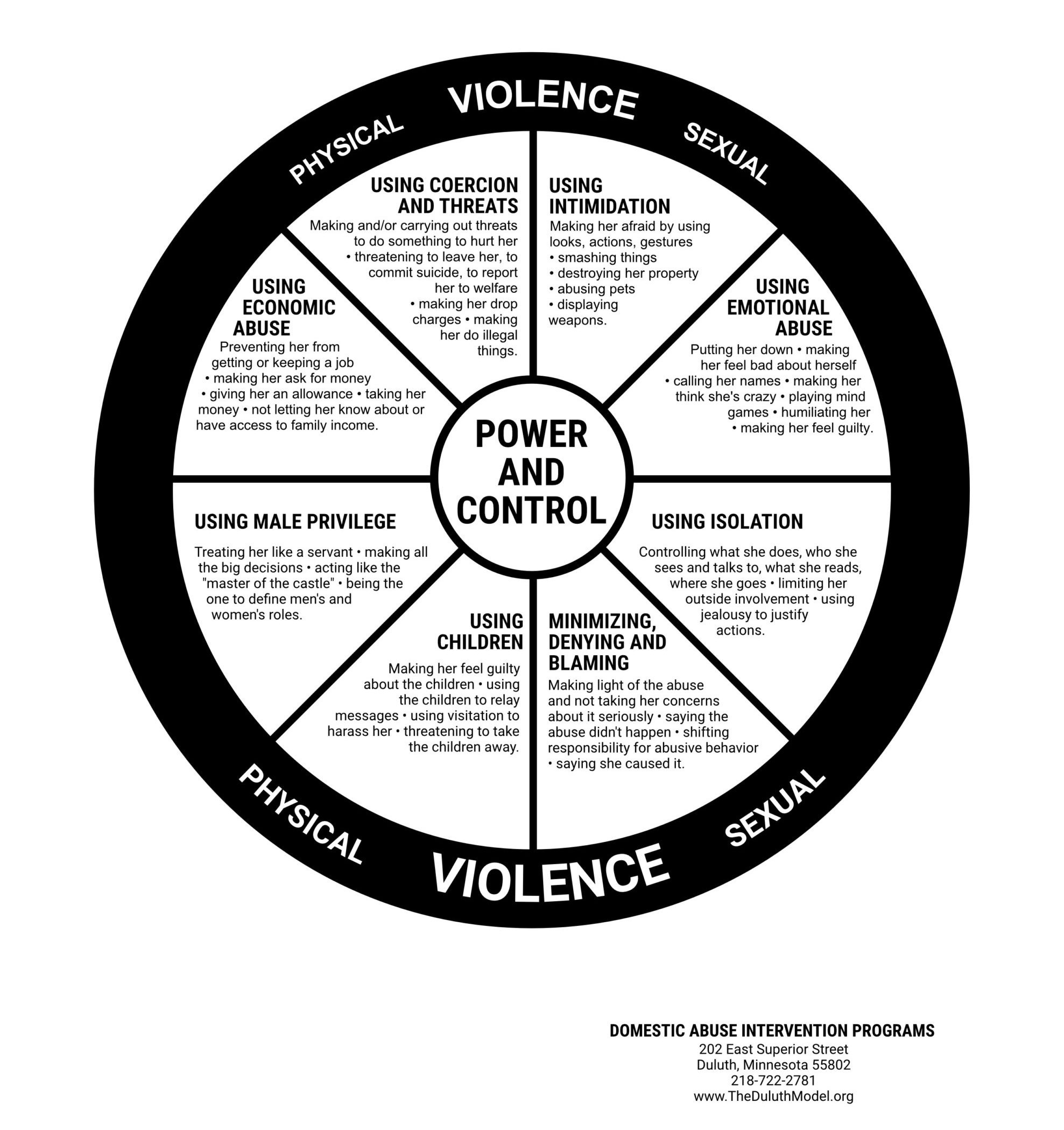
The extreme complementarian playbook maps directly onto established clinical markers of coercive control, sanitizing each tactic with holy vocabulary.
The first and most pervasive of these markers is the use of intimidation and emotional abuse. In the toxic theology of the hate-grift, emotional abuse is routinely framed as “spiritual authority” or “church discipline.” Rather than leading with the sacrificial love of Christ, these men manage their homes through psychological violence, using verbal attacks, insults, and derogatory comments systematically designed to induce profound insecurity and erode a woman’s self-esteem. By cloaking insults in the language of spiritual correction, the abuser ensures the victim can’t defend herself without appearing to rebel against God.
The second supporting spoke is economic abuse, fiercely defended by the movement as the “single-income biblical design.” The modern patriarchy movement aggressively promotes rigid household structures in which women are explicitly barred from career pursuits and higher education. This isn’t a harmless aesthetic preference for traditional domesticity; it’s an intentional mechanism of financial control. Stripping a woman of her earning potential restricts her liberty, creating profound financial dependency, which clinical literature identifies as a primary reason victims are forced to remain trapped in abusive relationships. Without access to their own resources, women are entirely beholden to the men who control the bank accounts, stripping them of the agency required to flee a dangerous environment.
The Duluth Wheel identifies “Isolation” as a core tactic of the abuser. In the home, this looks like a husband controlling his wife’s friendships, monitoring her communications, and restricting her movements. But the modern patriarchal movement has scaled this isolation to an institutional level.
Consider Doug Wilson’s recent advocacy for “household voting”—the explicit demand to repeal the 19th Amendment and strip women of their right to vote. What’s sold to the congregation as a noble defence of “household unity” is, in reality, the ultimate manifestation of isolation. It’s an attempt to erase a woman’s civic existence legally. By arguing that a husband’s vote absorbs his wife’s voice, the movement seeks to build an “invisible cage” of coercive control that extends from the kitchen to the ballot box, using micromanagement, emotional manipulation, and the total restriction of her liberty. It proves that the endpoint of this theology isn’t the flourishing of the family, but the absolute, legal erasure of female autonomy.
To keep this wheel of control turning smoothly, the patriarchal home relies on a foundational layer of systemic gaslighting. Gaslighting is a highly strategic form of communication and manipulation involving deception, misdirection, and contradiction that leads an individual to question their own beliefs, perceptions, feelings, and mental health. It’s not a loud, physical assault; rather, it’s an insidious form of indirect bullying that plants deep seeds of doubt in the victim’s mind over time.
What makes the hate-grift so exceptionally destructive is that this gaslighting is institutionalized. The theological gaslighter’s goal isn’t merely to control their partner’s daily actions; they strive to make the victim surrender entirely, forcing them to accept a permanent dynamic of absolute obedience and submission. Because the theology has already conditioned women to “self-silence”—meaning they instinctively suppress their own needs and desires to prioritize their partner to the point of total self-sacrifice—they become ideal, highly vulnerable targets for this form of psychological manipulation.
When the abuser behaves cruelly, irrationally, or tyrannically, the theology gaslights the woman into believing she’s inherently at fault for failing to submit properly. The victim is trapped in a devastating paradox in which recognizing the abuse is framed as a spiritual failure. She’s told she can’t trust her own mind, her own pain, or her own reading of reality.
Because white-collar domestic violence can be subtle and hidden behind a veneer of middle-class respectability, it’s vital for women caught in these environments to recognize early warning signs and map out a safe exit strategy. Recognizing the abuse is the critical first step toward dismantling the physiological and psychological cages built around them.
Tragically, for women seeking to reclaim their agency, traditional church counselling is often fundamentally unsafe. Pastoral boards in extreme complementarian environments are structurally designed to protect the male leadership paradigm, frequently directing women to endure psychological torture, pray harder, and submit further. Intervention requires systemic disruption.
Safety planning is paramount and often must bypass compromised religious institutions. Fortunately, modern digital technologies are increasingly effective tools for discreetly combating domestic violence. Existing prevention and intervention applications are explicitly designed for individuals in crisis and rely on rigorous safety planning and strategies to prevent revictimization. These digital tools provide strong privacy and anonymity, making them a preferred, secure way for women to access integrated educational resources discreetly, recognize clinical warning signs, and connect with professional support networks without an abuser’s knowledge.
If you’re currently navigating one of these environments and need to map out a secure exit strategy, please bypass your local church boards and use professional clinical resources immediately. You can begin building a personalized, anonymous safety plan right now by visiting the National Domestic Violence Hotline’s Safety Planning Resource.
Escaping the hate-grift requires a profound intellectual and spiritual awakening. It requires acknowledging that the “servant leader” template has been weaponized. When a woman is equipped to identify economic abuse, isolation, and systemic gaslighting for what they truly are, the spell of the ideology begins to break. By stepping outside the suffocating confines of coercive control and accessing secure, anonymous resources, women can begin the vital work of recovering their voices and dismantling the invisible cages built around them.
The Pathology of Subjugation
The theological cage constructed by the modern patriarchy movement isn’t merely a metaphor; it’s a clinical pathogen. The devastation of this hate-grift is significant, extending beyond the sanctuary and placing a shockingly high toll on the human body. The physical toll of subjugation isn’t an abstract concept. It’s a staggering clinical reality that approximately 80% of patients diagnosed with autoimmune diseases are women.
To help you understand why this happens, I’ll explain the complex science of immunology in more accessible terms. Think of your immune system as an elite internal security force designed to distinguish between foreign invaders and your own healthy tissue. In a safe, regulated environment, this force fiercely defends you. But under conditions of chronic, inescapable interpersonal stress, the force becomes profoundly disoriented and begins to panic. In its state of total alarm, it turns its weapons inward, attacking the very body it was designed to protect.
This biological misfire is deeply tied to the foundational genetic architecture of the female body. Genetically, women possess two X chromosomes, giving them a “double dose” of immune-related genes compared to men. To prevent dangerous overexpression of these genes, female embryos undergo X-inactivation, in which one X chromosome in each cell is silenced. This vital silencing is mediated by the long non-coding RNA Xist, which coats the inactive X chromosome and forms the Xist ribonucleoprotein (RNP) complex.
Recent clinical breakthroughs have identified this Xist RNP complex—which is present only in females—as a significant immunogenic driver of sex-biased autoimmunity. Every cell in a woman’s body contains XIST. When a female cell dies due to severe cellular distress or tissue injury, XIST RNPs are invariably exposed to the extracellular space and the immune system. Because these large nucleic acid-protein complexes cluster, they act as a biological tripwire, triggering Toll-like receptor pathways in the innate immune system and leading to autoantibody production.
When a woman is forced to live in a chronic state of marital or environmental hostility, her unique biological architecture makes her distinctly vulnerable. The systemic trauma and cellular distress pull the tripwire, initiating a cascade in which the body actively attacks itself.
The connection between the mind and the body isn’t just a metaphor; it’s hardwired biology. The neurobiology of toxic stress violently exacerbates a woman’s genetic vulnerabilities. When a woman lives under the suffocating weight of coercive control, her brain interprets her own home as an active war zone.
Normally, our biological alarm system is meant to handle temporary threats. But when a woman is trapped in a toxic environment, the danger-detection centre in her brain never shuts off. It triggers a constant, daily flood of stress hormones like cortisol into her bloodstream. This state of perpetual panic doesn’t just make her feel anxious—it fundamentally rewires her immune system.
When the body is drowning in stress hormones, it redirects its energy. It shifts away from routine cellular defence and basic repairs, leaving the body physically vulnerable. The physical toll is measurable: clinical studies show that under severe psychological stress, the skin’s protective barrier weakens and physical wounds take significantly longer to heal. Research even shows that a single hostile argument with a spouse can measurably delay the body’s ability to repair a cut.
Under the constant, heavy weight of subjugation, a woman’s immune system becomes exhausted and deeply confused. It drops its defences against real external threats—like viruses or bacteria—while simultaneously becoming dangerously hyper-reactive. Firing blindly in a state of neurochemical panic, the immune system begins attacking the body’s own tissues.
This physiological breakdown is intrinsically tied to the psychological demands of the hate-grift. The extreme complementarian movement demands that women subordinate their voices, minds, and needs to male headship. In clinical psychology, this is known as “self-silencing”—the frequent and excessive inhibition of one’s authentic self-expression to preserve relational harmony.
Women are socially and theologically conditioned to suppress their voices, anger, and needs out of fear of harming connections with men, prioritizing their partner’s desires and conforming to traditional feminine stereotypes. According to the Self-Silencing Theory, women with cognitive schemas focused on forming and maintaining close relationships are more likely to experience depression as a result of these demands. Traditional gender roles shape individuals’ schemas, self-confidence, and emotion-regulation strategies, creating a double burden for women who must navigate societal pressures while burying their own identities.
This relentless suppression creates a destructive cycle: women swallow their anger to keep the peace, which leads to resentment, eventual outbursts, and subsequent self-blame and guilt. When a domineering partner introduces gaslighting, it acts as a primary psychological vehicle, creating deep cognitive dissonance and mediating the direct relationship between self-silencing and severe psychological distress. The body simply can’t be gaslit, and the trauma eventually demands to be felt.
Case Study: The Body Keeps the Score of Coercive Control
When theological headship metastasizes into coercive control, the resulting trauma acts as a literal environmental pathogen. Consider the clinical case of “Marka,” a physician and mother who woke one morning with severe polyarthralgias and circular bruises on her legs. Her diagnosis was erythema nodosum, a painful autoimmune disorder. The onset of her physical illness wasn’t random; it correlated directly with the suffocating micromanagement, silent treatments, and gaslighting she endured from her husband.
For years, Marka had absorbed his arrogance, his incessant criticism of her thoughts, and his interference with her basic self-care and sleep. She experienced the classic symptoms of interpersonal trauma under coercive control: dissociation, palpitations, hopelessness, self-doubt, and the absence of enthusiastic consent. In retrospect, the vague bodily pains she had felt months earlier were likely immune complexes slowly forming and accumulating in her system. She even recalled migraines from a few years earlier that vanished completely when she went on a 5-day vacation, safely away from his harassing demands.
Her autoimmune condition materialized as a disturbing physiological mirror of her toxic marriage. Her body was attacking itself, internalizing the negative projections and messages of her hostile, shame-prone, and ragingly envious husband. Marka’s story is a harrowing clinical testament to the fact that coercive control isn’t just emotionally damaging; it’s physically destructive.
Faced with this terrifying intersection of biological vulnerability and theological hostility, women are adapting. An increasing number of women are voluntarily choosing celibacy, intentional singleness, or stepping away from traditional marital paradigms altogether. While patriarchal influencers frame this as a cultural rebellion or the failure of feminism, epidemiological data suggests it’s a highly rational, biologically protective pivot.
Longitudinal studies examining the association between marital trajectories and successful aging reveal a stark, undeniable gender disparity. For men, almost every marital trajectory—including being continuously married or becoming married after a baseline—results in significantly higher odds of successful aging than for men who were never married. Marriage fundamentally protects men’s health, mental stability, and longevity.
However, for women, the data tells a drastically different story. Marital status trajectories are of minimal importance for women, with continuous marriage offering no significant difference in successful aging compared to never-married women, and transitioning from married to not married actually lowering the odds of successful aging.
When the institution of marriage is culturally weaponized to demand self-silencing, and when the men entering those marriages have been groomed to exert coercive control, the partnership ceases to be a mutual sanctuary. It becomes a health hazard. Women are recognizing that tying themselves to an ideology that views their autonomy as a threat is biologically dangerous. Opting out of these specific marital structures isn’t a rejection of love; it’s a profound survival mechanism designed to protect their immune systems, sanity, and lives from the devastating toll of the hate-grift.
Walking away from this spiritual and relational abuse requires a shattering of old frameworks. We must recognize that deconstruction is often a trauma response and, for many, an intellectual awakening. It’s the recovery of the mind and the body from a theology that demanded their sacrifice.
Sovereign Grace in the Wilderness
To sustain their highly lucrative ecosystem of control, the architects of the patriarchal hate-grift have performed a radical theological sleight of hand: they’ve completely reimagined Jesus Christ. They’ve stripped away the compassionate, boundary-breaking rabbi of the Gospels and replaced him with a militant mascot for male supremacy. But the historical Jesus stands in stark contrast to the pious tyrants who invoke his name to subjugate women.
In a deeply patriarchal ancient world where women were systematically marginalized and treated as little more than property, Jesus continually elevated, protected, and listened to them. He explicitly defied the rigid, hypocritical gender codes of his era, famously entrusting the most critical theological reality of his ministry—his resurrection—to female disciples. He defended women against the religious legalists of his day, dismantling the structures that sought to stone, silence, and shame them. The heavy, suffocating yoke of the modern complementarian grifter bears no resemblance to the Christ who promised rest for the weary and true freedom for the captive.
For those who’ve recognized the physical and spiritual sickness of this ideology, leaving the pews of these high-control environments is often a terrifying leap. If you’ve fled this toxic theology, you likely find yourself in the “Wilderness”—a disorienting, lonely space outside the institutional church. The architects of the empire will tell you that leaving is a sign of spiritual failure or emotional rebellion. But we must be absolutely clear about what’s happening in the Wilderness. Stepping away from the empire can certainly be a trauma response—a biological and psychological necessity to escape coercive control—but, crucially, for many, it’s also a rigorous, beautiful intellectual awakening.
It’s the profound recovery of the mind. When you stop self-silencing and begin to critically examine the ransom-note theology that binds you, your intellect is no longer a liability to be managed; it’s an instrument of liberation. You’re not abandoning God by leaving an abusive system; you’re recovering the mental clarity required to see him as he truly is. Research emphasizes that stepping out of isolation and participating in social interventions or support groups can significantly contribute to this post-traumatic recovery process. Finding safe spaces to break the silence allows victims to move beyond their sense of aloneness, opening the door to genuine recovery and transformation.
The patriarchal grift thrives on the lie that you can’t survive without their prescribed submission. They offer a gilded cage, built on the frantic fear that female strength will somehow burn the house down. But the Gospel offers a counter-vision that’s both terrifying to the religious status quo and liberating to the Kingdom of God. The Creator didn’t design women to be safely contained; he made them dangerous to the darkness. He designed the ezer kenegdo as a fierce, rescuing warrior-ally.
The Kingdom of God doesn’t need more women who are afraid of their own strength or who have shrunk their souls to fit into a cultural box of manufactured compliance. It needs women whose minds, bodies, and spirits are fully restored. The path forward is one of resilience and reclamation. Let the gatekeepers keep their exegetical fortresses and their monetized outrage. Out here in the Wilderness, the morning is breaking, and it’s time to unleash the warriors they tried to bury.
Postscript
We’ve covered incredibly heavy, sobering ground today. When you finally confront the clinical reality of this theology, the sheer weight can feel overwhelming. If you’re standing in the wreckage of these systems and wondering how to survive the fallout, I want to point you toward a roadmap for healing.
I highly recommend revisiting our previous piece titled Triage in the Wilderness. It offers practical, hopeful next steps for tending to your spiritual and physical wounds. In that piece, we explore how taking your faith apart isn’t an act of defiance but an act of emergency battlefield medicine to stop the bleeding. We discuss why fleeing a high-control environment is a physiological flight for survival that often matures into a rigorous intellectual awakening. Most importantly, it outlines how true healing requires moving away from a ministry of theological correction and toward physiological and spiritual regulation. You don’t just have to survive out here; you can heal and emerge as a “Wounded Healer” who possesses a hard-won hermeneutical freedom.
References
Gender and Mental Health: Challenges Faced by Women and a Feminist Perspective (Odacı & Türkkan, 2026)
Meeting Prevention Beyond Awareness: A Qualitative Study Exploring Attitudes and Beliefs Towards Dating Violence... (Saial et al., 2026)
The mediating role of gaslighting as a psychological violence between self-silencing and psychological distress (Aras & Demir-Kaya, 2026)
Self-Silencing among Married Women: Impact of Age, Marital duration, and Gender Stereotypes (Rahma & Bindu, 2025)
The association between trajectories of marital status and successful aging varies by sex... (Ho et al., 2025)
Psychoneuroimmunology (Tausk, Elenkov, & Moynihan, 2008)
Auto-Immune disorder and interpersonal trauma from coercive control: a case example (Giroux, 2025)
The Prevalence of Autoimmune Disorders in Women: A Narrative Review (Angum et al., 2020)
Xist ribonucleoproteins promote female sex-biased autoimmunity (Dou et al., 2024)


