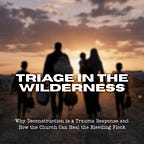

In our previous essay, Predator’s Playbook, we examined the devastating architecture of evangelical gullibility. We explored how the culture war’s rigid, unyielding binary stripped the institutional Church of its capacity to recognize clinical pathology, training an entire generation to ignore their moral intuition. We saw how systemic blind spots allowed apex predators—from literal psychopaths to political strongmen—to infiltrate the sanctuary by deploying a mechanical “vocabulary of absolution” and promising to fight the secular left.
We first examined how the fortress gates were opened, and now we must turn our attention to the wreckage left behind and to the bleeding flock.
When a person has been crushed by the systemic manipulation we outlined in the Playbook, the resulting devastation is often dismissed by the wider evangelical culture as mere “church hurt.” That phrase is a tragic minimization. It implies that the victim is overly sensitive, nursing a petty grievance over a worship style or a theological disagreement. But true spiritual abuse is a profound violation. It occurs when a human being operates under the guise of a divine calling to manipulate, coerce, and subjugate. When the place of ultimate safety—the sanctuary—becomes the site of ultimate danger, the resulting trauma shatters not only the mind but the body.
We’re witnessing a mass exodus from the pews, with millions of believers stepping outside the fortress and into the disorienting wilderness. The established Church has largely responded to this exodus with defensive posturing, slapping it with the catch-all label of “deconstruction” and treating it as a hostile, intellectual rebellion against God. They launch apologetic counter-attacks, attempting to argue the wandering sheep back into the fold, but this approach fails because it fundamentally misdiagnoses the wound.
Spiritual abuse precipitates a profound crisis that’s both physiological and intellectual. The deconstruction we’re witnessing isn’t a rebellion; for many, it’s an act of triage. Fleeing the high-control environment is a trauma response—a desperate bid for safety by an exhausted nervous system battered by authoritarian control. Yet once outside the echo chamber, this physiological flight for survival often matures into a rigorous intellectual awakening. From a safe distance in the wilderness, the survivor is finally free to dismantle the rigid, weaponized binaries they were conditioned to accept. They can finally read the ancient texts without the distorted lens of their abuser.
To help these survivors find a way back to Christian fellowship, the Church must undergo a radical shift in its pastoral care. We must honour both realities of the survivor’s experience by treating the wounds of the nervous system with deep, incarnational patience and establishing physical and emotional safety long before we attempt theological correction. Simultaneously, we must respect their intellectual awakening, acknowledging that their deconstruction is often a faithful pursuit of the truth that predatory systems sought to hide.
The path back to fellowship doesn’t begin with an argument. It begins with the body.
The Origin of Triage
Before we examine the wreckage left in the wake of spiritual predators, we need to establish precise vocabulary for what happens to those who survive them. Throughout this essay, we’ll frequently refer to leaving an abusive religious system—and the subsequent unravelling of faith, broadly labelled as “deconstruction”—as an act of triage.
To understand why this distinction is vital to our paradigm shift, we must look at the word’s origin.
The word triage originates from the French verb trier, meaning “to sort, separate, sift, or cull.” In its earliest usage, it was an agricultural term used by 18th-century merchants to describe the mundane process of sorting coffee beans or separating the finest wool from a fleece.
But the word was baptized in blood during the Napoleonic Wars. The chief surgeon of Napoleon’s Imperial Guard, Baron Dominique Jean Larrey, witnessed the battlefield’s devastation. At the time, wounded soldiers were often left to die or treated strictly by military rank and social status rather than by medical need. Larrey revolutionized military medicine by introducing a system of triage. He mandated that the wounded be rapidly sorted into categories based solely on the severity of their injuries and their immediate need for intervention, regardless of whether the bleeding man was a decorated general or a lowly foot soldier.
In emergency medicine, triage isn’t about physical therapy, gentle rehabilitation, or long-term wellness. It’s the brutal, hyper-focused calculus of immediate survival. It’s the battlefield medic realizing that to stop a systemic infection from killing a soldier, the crushed limb must be amputated.
For decades, the institutional Church has watched believers walk away from high-control environments and has mislabeled their departure as a hostile, intellectual rebellion. We’ve treated them as if they’re simply consumers, leisurely sorting through theological preferences and picking and choosing which doctrines they prefer. We’ve judged them under the framework of the “Spiritualizer,” accusing them of weak faith.
But the survivor of spiritual abuse isn’t a consumer; they’re a casualty.
When a believer finally flees a predatory leader, their faith has been deeply infected by the authoritarian systems they were subjected to. The weaponized scriptures and the mechanical “vocabulary of absolution” that protected their abuser are actively destroying their peace and sanity. Taking their faith apart isn’t an act of defiance; it’s an act of emergency battlefield medicine. They’re systematically separating the toxic from the true. They’re amputating the high-control systems that kept them captive to save their “Embodied Soul.”
They’re trying to stop the bleeding.
To properly shepherd these wandering sheep and help them find their way back to a healthy fellowship, we must first understand the nature of their wounds. We must stop treating them as rebels and start recognizing them as survivors in triage.
The Anatomy of a Soul-Wound
To understand the mass exodus from the pews, we must first examine the specific nature of the injury that caused it. The anatomy of a soul-wound is fundamentally different from that of a secular psychological injury. It goes deeper than a standard interpersonal conflict because it trespasses into the sacred centre of a human being.
In a conventional abusive dynamic—whether in a workplace or a domestic setting—the abuser relies on physical, emotional, or financial leverage. The victim, though trapped and traumatized, still has a conceptual escape hatch: they can appeal to a higher authority. They can go to HR, call the police, or, crucially, cry out to God for justice against their oppressor.
Spiritual abuse removes that escape hatch. In these toxic environments, the abuser co-opts God’s voice, authority, and posture. The pastor or leader doesn’t merely claim to represent God; functionally, they position themselves as the necessary mediator of God’s will.
When this happens, the sacred is weaponized. Legitimate theological concepts—submission, obedience, dying to self, and church discipline—are twisted into tools of coercion. If you question the leader, you’re not merely insubordinate; you’re “touching the Lord’s anointed.” If you set a personal boundary, you’re not exercising healthy agency; you’re “rebellious” and “prideful.” By fusing their personal demands with the decrees of Heaven, the spiritual predator overrides the victim’s natural defences.
God wired the human body with an instinct to flee danger. But how do you flee when your abuser has convinced you that leaving their control means walking out from under the “umbrella of God’s protection”? The victim is paralyzed by a terrifying hostage situation of the soul: to stay is to be crushed by the leader, but to leave is to risk the wrath of Almighty God.
This paralyzing dynamic produces what psychologists call Betrayal Trauma. This form of trauma occurs when the people or institutions a victim utterly relies on for safety, survival, or spiritual formation become the source of profound harm.
To grasp the depth of this trauma, we must understand the geography of the believer’s heart. For the devoted Christian, the sanctuary isn’t merely a building; it’s a refuge. The Church is designed to be a hospital for the broken. It’s the place where a person brings their deepest vulnerabilities, confesses hidden sins, and seeks ultimate truth.
When a spiritual leader exploits that vulnerability—using a confession against a congregant, manipulating their desire to serve, or grooming them for exploitation—the resulting cognitive dissonance is shattering. The disorientation is absolute because the compass itself has been magnetized to point toward danger.
The victim’s brain struggles to process the contradiction. The man who preaches grace on Sunday morning is the same man gaslighting the staff on Tuesday afternoon. The elders who pray over the sick are the same men who silence victims of assault to “protect the church’s witness.” This hypocrisy breaks the foundational trust required for human flourishing. The sanctuary, once the symbol of ultimate safety, becomes neurologically coded as the site of ultimate danger.
The staggering cost of escape compounds the devastation of spiritual abuse. The architecture of an authoritarian church environment is designed to make leaving catastrophically expensive.
When a victim finally gathers the courage to leave, they don’t merely lose a Sunday morning routine. Because high-control religious environments demand totalizing allegiance, the victim’s entire life is usually entangled in the organization.
Leaving often means the immediate loss of their social safety net, when lifelong friendships are severed overnight. Former friends are instructed not to associate with the “divisive” or “backslidden” individual. In extreme cases, family members who remain in the system are pressured to cut off contact, fracturing marriages and dividing parents from children. For those employed by the church or whose businesses rely on the congregation, leaving means financial ruin and the loss of career identity. And when the victim is cast into an existential void, forced to untangle the genuine voice of the Good Shepherd from the wolf’s bark, they often lose their theological certainty.
This multi-tiered loss creates an isolating vacuum. The victim is pushed out into the cold, often bearing the stigma of being labelled the “problem.” The church system closes ranks to protect its own power. It often falls back on the “Spiritualizer” mindset, whispering that the departed believer lacked faith, harboured secret sin, or failed spiritually.
Stripped of their community, their identity, and their spiritual moorings, the survivor is left entirely alone to process a wound that their former community refuses to acknowledge exists. They’re not merely wandering; they’re bleeding out. And it’s this bleeding—this visceral, physiological crisis—that drives the desperate triage of deconstruction.
The Somatics of Spiritual Trauma
When we discuss spiritual abuse, our language often defaults to the ethereal. We talk about “broken spirits,” “crises of faith,” or “theological wounds.” While these descriptions are valid, they’re also incomplete. They inadvertently reinforce a dangerous Gnostic heresy—the belief that the spirit is completely separate from the body and that human beings are merely floating souls untethered from their biology.
As we established in The Fractured Mirror, the Christian view of the human person is the Embodied Soul. God formed man from the “dust of the ground” (biology and matter) and breathed into him the “breath of life” (spirit and transcendence). We’re an inseparable union of dust and breath. Therefore, when the “breath” is violently assaulted by spiritual abuse, the “dust” absorbs the shock. The devastation isn’t merely philosophical; it’s intensely physiological.
To understand why a survivor can’t simply “get over it” and return to the pews, we must examine how abuse physically alters the human brain and nervous system.
When a person experiences a terrifying event, the brain’s alarm centre (the amygdala) activates the sympathetic nervous system. It floods the body with stress hormones such as cortisol and adrenaline, drastically altering heart rate and respiration to prepare the body to either fight or flee.
The human brain evolved to respond to immediate physical threats, such as a charging predator. However, the amygdala can’t distinguish between a physical threat to life and a profound psychological threat to existence. When an abusive pastor stands in the pulpit and implicitly threatens a congregation with divine retribution, or when a spiritual leader threatens a victim with the total loss of their community, the brain registers a life-or-death survival threat.
The victim’s heart rate spikes. Their breathing becomes shallow. The body prepares to run, but the victim is sitting in a church pew, paralyzed by the terrifying belief that fleeing the building means fleeing the presence of God. Because they can’t physically fight or run, the physiological stress response is never resolved. The nervous system becomes trapped in a state of high alert, its alarm bells ringing endlessly.
This unresolved survival energy leads to chronic nervous-system dysregulation. The survivor’s biological threat-detection system is impaired, constantly perceiving danger even in perfectly safe environments. This dysregulation typically manifests as primal survival responses: Fight, Flight, Freeze, or Fawn.
When a survivor attempts to re-enter a church building—or even opens a Bible or hears a worship song—their nervous system may involuntarily trigger Fight or Flight. This isn’t a conscious, intellectual rebellion against God; it’s a biological reflex. They may experience sudden panic attacks during worship. They might sit through a sermon in agonizing hypervigilance, their chest pounding as they scan the room for an invisible threat. Their brain is screaming, “You’re in danger. Get out!”
Conversely, a dysregulated nervous system might trigger the Freeze or Fawn response. In high-control religious environments, the “Fawn” response is particularly insidious because it’s frequently misdiagnosed as spiritual maturity. Fawning is a survival strategy in which a victim attempts to pacify their abuser by anticipating their demands and entirely subjugating their own needs.
In the church context, this looks like the “ideal congregant.” It’s the person who compulsively volunteers for every ministry, can’t set a boundary, and chronically people-pleases to their own detriment. Their frantic service isn’t the joyful fruit of the Spirit; it’s the frantic fawning of a hostage trying to stave off spiritual punishment. The church, which should be a sanctuary, becomes a theatre of performance where believers wear a “Mask of Joy” to hide their terror.
Because spiritual abuse is rarely a single, isolated incident of violence, survivors frequently develop Complex Post-Traumatic Stress Disorder (C-PTSD).
Traditional PTSD is often linked to a single, acute event. Complex PTSD arises from prolonged, repeated trauma in which the victim feels utterly captive. It’s the drip-drip-drip of manipulation—years of subtle gaslighting, public shaming disguised as “church discipline,” and the agonizing silence of complicit bystanders.
In clinical psychology, the physical wear and tear from this chronic stress is called Allostatic Load. Over years of exposure to a high-control environment, the survivor lives in a chronic state of cortisol saturation. This prolonged physiological stress literally ravages the body, leading to chronic fatigue, autoimmune flare-ups, insomnia, and debilitating migraines. The “dust” breaks down under the weight of the spiritual assault.
Understanding this neurobiology reveals the devastating cruelty of the traditional evangelical response to spiritual abuse. When a traumatized believer finally collapses under the weight of a dysregulated nervous system, the church too often responds with the false gospel of the “Spiritualizer.”
The Spiritualizer operates on the crushing premise that mental and emotional anguish are direct barometers of spiritual vitality. They view mental health struggles through the lens of sin and spiritual well-being. The logic applied to the survivor is brutal: If you’re feeling anxious in church, you’re not trusting God. If you’re deeply depressed after leaving your community, you have unconfessed sin.
Because the Spiritualizer views the root cause as entirely spiritual, they insist the cure must be entirely spiritual, demanding a form of spiritual bypassing. They tell the trembling, terrified survivor to “just pray about it,” to “read the Word more,” or to “submit to new leadership.”
This approach is actively re-traumatizing. It commits the Gnostic heresy by entirely ignoring the body, forcing a spiritual solution onto a physiological problem. Telling a victim of spiritual abuse to “just read your Bible more” to cure their panic attacks is akin to telling a person with diabetes to “just pray harder” for their insulin levels to regulate.
Worse still, it pushes the victim back into the exact mechanisms that were weaponized against them. If a predator used Scripture to subjugate a victim, handing that victim a Bible triggers a physiological flashback. If prayer were used as a tool for public manipulation, asking the victim to bow their head and close their eyes feels intensely unsafe.
By demanding that a shattered nervous system simply “perform” its way out of trauma, the Spiritualizer model produces deep shame and isolation. The survivor is told that their biological survival reflex is actually a sin against God. In their despair, they realize that to heal their body, they must flee the very people who claim to represent Christ.
This is the agonizing junction where flight becomes triage, and the great exodus of deconstruction begins.
Triage, Flight, and the Intellectual Awakening
When a survivor finally leaves a spiritually abusive environment, they rarely do so because they’ve carefully mapped out a new systematic theology. They leave because their biological alarm bells are deafening. They leave because the physical and psychological toll of staying has become a lethal threat to their embodied soul.
The institutional Church has largely misunderstood this exodus, slapping it with the catch-all label of “deconstruction” and treating it as an organized, intellectual rebellion against orthodox Christianity. Apologetics seminars are launched to counter the movement, treating these wandering sheep as hostile debate opponents. But this fundamental misdiagnosis ignores the reality of the trauma response. The path out of the sanctuary and into the wilderness is paved with necessity, not necessarily defiance.
To understand the early stages of deconstruction, we must stop viewing it as a theological betrayal and recognize it as spiritual triage. As a reminder, triage is the process of determining the priority of patients’ treatments based on the severity of their condition.
For the victim of spiritual abuse, their faith has become deeply infected by the venom of their abuser. The toxic, authoritarian theology that kept them subjugated—the weaponized scriptures, the constant threat of divine retribution, the performative demands of the “Spiritualizer” who insists that suffering is a sign of weak faith—is slowly killing them. Taking their faith apart is an act of emergency surgery. They’re amputating toxic, high-control systems to save their own lives and sanity.
This tearing down is terrifying. It’s deeply disorienting for a believer to dismantle the very structures they once believed housed the presence of God. But they’re driven by a survival imperative. They must remove themselves from the crushing expectations of the “Idol of Performance,” which demands they smile through their devastation. They’re seeking a place where their nervous system can stop bracing for the next spiritual attack.
Once the survivor is outside the high-control environment, a profound shift occurs. Distance creates safety, and safety changes the brain. As the constant threat of spiritual punishment recedes, the survivor’s nervous system slowly begins to regulate. They’re no longer trapped in the biological hostage situation of “fight or flight.”
As the amygdala quiets, the prefrontal cortex—the part of the brain responsible for complex, critical thinking—fully re-engages. At this juncture, the physiological fight for survival matures into a legitimate intellectual awakening.
Without the abuser’s looming shadow dictating how every verse must be read, the survivor experiences hermeneutical freedom. They can finally look at the scriptures, the historical context, and the traditions of the faith in their entirety.
The scales fall from their eyes, and they realize the abusive leader wasn’t just cruel; the leader’s theology was fundamentally flawed. It was structurally designed to protect human power, not to reveal divine character.
They begin to see the rampant use of proof-texting to silence dissent. They recognize how the doctrine of “submission” was distorted into a gag order and how “church discipline” was weaponized as an NDA. The intellectual awakening is the startling realization that the God they were running from was, in fact, an idol crafted in the image of their abuser.
This awakening is deeply liberating, yet a tidal wave of righteous anger accompanies it. It’s the anger of grieving a stolen text.
There’s a profound, visceral frustration in realizing, “The Bible doesn’t say what they told me it said.” The survivor looks back on decades of fear, only to realize the theological prison they were kept in was built on mistranslations, cultural overlays, and predatory manipulation.
We must validate this anger. For many, deconstruction isn’t a lazy drift into secularism; it’s a rigorous, exhausting pursuit of truth. They’re meticulously stripping away Western, authoritarian, and predatory overlays to uncover the actual, ancient faith beneath. They’re reclaiming their moral agency—an agency that high-control religion actively suppresses.
When a survivor questions the doctrines of their abusive church, they’re not necessarily abandoning Christ. Often, they’re desperately trying to clear away the wreckage of a false gospel so they can finally see Him clearly. They’re refusing to accept the “Materialist” reduction that their spiritual hunger is merely a chemical misfire, while simultaneously rejecting the “Spiritualizer” who demands unquestioning submission to corrupt leadership. They’re seeking the genuine breath of God.
The church often views this intellectual wandering as a tragedy, calling those who have left “lost in the wilderness.” But we must remember our own sacred history: the wilderness is a deeply biblical precedent.
Throughout Scripture, the wilderness isn’t a place of faithlessness; it’s a place of divine rehabilitation. When established religious structures become utterly corrupt—when the “temple” is filled with thieves and idols—God routinely leads His people into the desert to reintroduce Himself.
Consider the prophet Elijah in 1 Kings 19, who fled into the wilderness in absolute terror and exhaustion. He was running from the murderous, authoritarian regime of Jezebel. He was isolated, deeply depressed, and bearing the immense physical toll of his trauma.
If a modern, high-control church had treated Elijah, he would have been rebuked for abandoning his post and lacking faith. But God didn’t rebuke him. God met him in the wilderness. God tended to Elijah’s exhausted body first, providing sleep and nourishment. And when God finally spoke, it wasn’t in the terrifying, overwhelming displays of power—the wind, the earthquake, or the fire—that an abusive leader might use to demand submission. God spoke in a still, small whisper.
For the survivor of spiritual abuse, the loud, booming voices of the sanctuary have become deeply traumatizing. The wilderness is the only place quiet enough for them to hear the whisper. It’s the place where the golden calves of predatory church systems are left behind, and where the Good Shepherd binds up the wounds of the scattered flock.
To help these survivors find a way back to Christian fellowship, we can’t stand at the edge of the desert and yell at them to return to the very buildings that crushed them. We must be willing to walk out into the wilderness with them.
A Path Back to Fellowship
If the wilderness is the necessary place for triage and intellectual awakening, how do followers of Christ help survivors eventually find their way back to a healthy community?
The tragic reality is that the modern Church often tries to welcome traumatized believers back using the very methods that drove them away. We rely on traditional discipleship models that prioritize theological alignment and behavioural conformity. We try to argue them out of deconstruction, armed with apologetics and historical proofs. But when dealing with a survivor of spiritual abuse, traditional discipleship isn’t just ineffective; it’s actively repellent to a nervous system shattered by religious authority.
To shepherd a survivor back to safe pastures, we must undergo a radical paradigm shift in our pastoral care. We must move from a ministry of theological correction to a ministry of physiological and spiritual regulation.
Traditional discipleship models primarily focus on correcting bad theology, often using Scripture to provide rapid instruction and comfort. They frequently demand the immediate forgiveness of abusers and treat a quick return to regular church attendance as the ultimate measure of spiritual healing. However, trauma-informed pastoral care requires a complete reversal of these priorities. Rather than starting with theological correction, it focuses entirely on establishing physical and emotional safety. Rather than demanding premature forgiveness, it validates the victim’s righteous anger and deep grief. Rather than pushing for a quick return to the sanctuary, it encourages the practice of “co-regulation” in safe spaces outside the church walls. Crucially, a trauma-informed approach recognizes that the very scriptures and spiritual disciplines meant to bring comfort may currently act as severe physiological triggers, and it adapts patiently.
You can’t teach a drowning person to swim. You must pull them out of the water, clear their lungs, and wrap them in a blanket. Only when they’re breathing normally on dry land can you discuss swimming techniques.
The same is true for the survivor of spiritual abuse. Establishing physical and emotional safety is the absolute prerequisite for spiritual healing. A dysregulated brain, trapped in the survival states of fight, flight, or freeze, is biologically incapable of processing complex theological arguments or experiencing the peace of God. Therefore, the first step on the path back to fellowship isn’t a Bible study; it’s establishing a safe environment.
This requires a profound shift in our posture, moving away from viewing the broken as “projects” to be solved and instead embracing them as people to be loved. We must practice the Ministry of Presence. Borrowing from the Jewish tradition of “sitting Shiva,” we must learn to sit in the ashes with the grieving, often in silence, without rushing to turn the lights on or fix the problem. We witness their pain, validating it as a real, grievous wound rather than dismissing it as a lack of faith.
Because trauma occurs within relationships, healing must also happen within relationships. Human nervous systems are designed to regulate one another. When a person is intensely anxious, being in the presence of a calm, grounded, emotionally safe person can lower their heart rate and signal to their brain that the threat has passed. This neurobiological process is called co-regulation.
Followers of Christ must become “safe bodies” for survivors to be around. This means engaging with them without an agenda, without pressure, or spiritualized language, or manipulation. It means setting aside defensive apologetics and simply offering a quiet, steady, non-judgmental presence. When a survivor realizes that you’re not going to quote a verse at them, correct their theological anger, or pressure them to attend Sunday service, their nervous system will slowly begin to down-regulate in your presence. You become a living, breathing sanctuary.
To offer this kind of holistic care, the Church must dismantle the unnecessary, prideful wall between pastoral counselling and clinical therapy. We must embrace the theology of the Embodied Soul, recognizing that, as an inseparable union of “dust” and “breath,” we must treat the whole person.
For too long, the Church has been trapped in a false binary between the sacred and the scientific. We’ve operated under the “Spiritualizer” mindset, which treats therapy as a rival religion and insists that prayer and Bible study are the exclusive cures for mental and emotional anguish. Yet spiritual trauma physically rewires the brain and weakens the body. Expecting a pastor to treat complex, trauma-induced physiological dysregulation isn’t only ineffective; it borders on negligence.
A “disarmed” church practices integration. It requires pastors to humbly acknowledge that they’re not psychiatrists and demands that we build bridges with the medical community.
To safely bring survivors back into fellowship, we must build robust referral networks in which pastors work with qualified therapists. In this integrated model, the pastor attends to the sufferer’s spiritual direction and community integration. At the same time, the clinical therapist provides the evidence-based tools and trauma processing necessary to heal the nervous system. This beautiful partnership is the “Great Household” functioning as it should, destroying the shame victims feel for seeking clinical help and using every gift of Common Grace to restore the human person.
For many survivors, the physical architecture of a church building—the pews, the pulpit, the worship music—is a profound neurological trigger. If we demand that they return to the building to experience Christian fellowship, we’re demanding that they continually re-traumatize themselves.
We must redefine fellowship beyond Sunday morning attendance. We must embrace Incarnational Ministry by meeting survivors exactly where they are.
Jesus didn’t confine His ministry to the synagogue. He met the traumatized, the marginalized, and the broken at ancient wells, on dusty roads, and at dinner tables. If the sanctuary is currently a site of terror for a survivor, the coffee shop, the living room, and the park bench must become the new sites of fellowship. Bringing Christ’s presence to them in an environment they control is the highest form of pastoral care.
Ultimately, the core of spiritual abuse is stolen agency. The authoritarian leader strips the victim of their right to choose, question, and say “no,” replacing the victim’s conscience with the leader’s demands. Therefore, the absolute core of healing is the restoration of that stolen agency.
To help a survivor heal, we must give them the explicit, guilt-free right to set boundaries. We must permit them to say “no” to our invitations without fear of spiritual retaliation. We must allow them to move at a glacial pace, recognizing that their intellectual awakening and physiological healing can’t be rushed.
When we return to their agency, we prove that our love isn’t contingent on their compliance. We prove that we’re not predators hiding behind a new theological mask. By offering a safe, regulated presence, integrated clinical care, and absolute freedom, we slowly demonstrate that while the wolf may have worn the Shepherd’s clothing, the true Good Shepherd is still out there, waiting in the wilderness, ready to carry them home.
The Scarred Body of Christ
When a survivor of spiritual abuse begins to heal, the institutional Church often harbours a quiet, unspoken expectation: we want them to return to the pews exactly as they were before. We desire a sanitized redemption narrative in which the trauma is entirely erased, the difficult questions are dropped, and the believer joyfully resumes their place in the machinery of the congregation. We’re tempted to bow to the “Idol of the Cure,” demanding an instant, unblemished fix so that our own comfort isn’t disrupted.
But that’s not how resurrection works.
When Jesus Christ rose from the dead, He didn’t return with a flawless, untouched body. He retained His scars. He carried the physical evidence of His trauma into eternity, deliberately presenting His pierced hands and side to Thomas. If the sinless Saviour kept His scars, the Church must fundamentally abandon the expectation that a survivor of spiritual abuse will return to us without theirs.
The goal of trauma-informed pastoral care isn’t to pretend the abuse never happened. The goal is integration. When a survivor eventually finds their way back to Christian fellowship, they’ll look different. They’ll no longer be the compliant, fawning congregant whose boundaries can be easily overrun. They’ll ask rigorous, uncomfortable questions. They’ll fiercely reject the false gospel of the “Spiritualizer” who demands they put on a “Mask of Joy” to hide their pain. They’ll possess a hard-won hermeneutical freedom.
We must recognize that this change isn’t a sign of rebellion; it’s the mark of a “Faithful Wrestler.” The believer who has survived the wilderness, dismantled a predatory theology, and fought their way back to the true Christ isn’t a threat to the church. They’re a profound gift. They return as “Wounded Healers” who possess a depth of empathy and an intolerance for wolves that the untested congregation desperately needs.
However, they’ll return only if the Church is willing to change. We can’t simply unlock the doors on Sunday morning and expect the traumatized to walk back into the very architecture that crushed them. We must become a true Sanctuary again—a place where the broken aren’t “projects” to be solved but embodied souls to be loved. We must stop trying to argue wandering sheep out of their deconstruction and instead practice the Ministry of Presence, willing to sit in the ashes of their grief without rushing them towards a premature hallelujah.
Spiritual abuse is a terrifying violation. It’s the predator’s ultimate playbook: wearing the mask of a god to sever the sheep from the Shepherd. But the true Good Shepherd isn’t deterred by the wilderness. He doesn’t stand on the porch of the sanctuary, angrily demanding that the bleeding sheep perform their way back to the pen. He leaves the ninety-nine, walks out into the desolate places, and sits with us in the wreckage of our deconstructed faith.
True Christian fellowship is strong enough to hold our deepest doubts, our most righteous anger, and our most profound psychological traumas. It’s a “Great Household” built not on authoritarian coercion but on safety, patience, and incarnational love. For those whose sanctuary has shattered, the road back is long and fraught with triggers. But they don’t have to walk it alone. The wolf may drive the flock, but the Good Shepherd carries the bruised sheep.


